Picture this.
A user is scrolling through search results, trying to find the perfect answer to their problem.
Suddenly, a snippet catches their eye.
It sounds like the perfect solution to their problem.
They click and are redirected to your website.
Magic? Not quite.
Those catchy text snippets that show up in search results are called meta descriptions.
This meta description is what users read and then use, to decide whether your article is worth reading.
So, do not underestimate the power of meta descriptions.
These little snippets of text can literally make or break your website’s click-through rate.
Potentially, you could get a huge boost in traffic, all from a few carefully chosen words.
Before you begin
Here are some points you should think about, before you actually start creating a meta description –
- Whom is the article written for? What problem does it solve?
- What is your value proposition? Why is your content different from your competitors’? Your own expertise? A unique approach? Exclusive offers? Highlight these differences and strengths in your description without being too salesy of course.
How To Write Meta Descriptions That Are Irresistible
Simply put, your meta description should be used to summarize your content clearly.
But there are a few things you should bear in mind, while doing that.
Avoid click-bait
Don’t write misleading information just to lure visitors to your website. That can annoy them and make them leave your site immediately. Your bounce rate will increase. Google will eventually stop showing your website in the search results, for those keywords.
This is a black hat SEO strategy that might possibly give you a quick boost for a short period – but can cause a lot of harm to your website’s reputation in the long run.
Get the Length right
Google typically displays meta descriptions up to 155-160 characters. And it uses an ellipsis (like so…) when the text is longer than the display area.
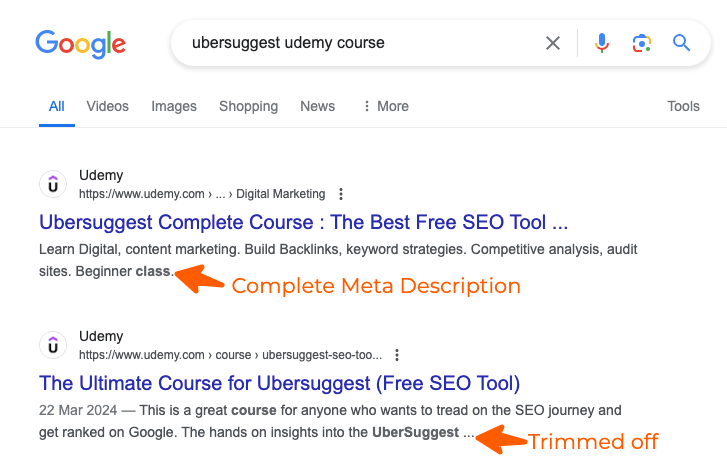
That’s why you should front-load the most important information within the first 120 characters, to make sure the most important part is visible in the search results.
Include a Call to Action (CTA)
Encourage users to interact with your website, with a strong call to action that matches the searcher’s intent. For example, adding verbs like “Learn More,” “Shop Now,” or “Get Started,” can drive more clicks.
Include Keywords Naturally
Including relevant keywords into your meta description can help tell your users that your webpage is related to their search query.
So use keywords by all means – but in a way that seems natural and makes sense.
However, avoid stuffing keywords – i.e. forcibly using them out of context or repetitively.
Make it emotional
Your meta description is like an advertisement for your website’s content. So use it effectively to appeal to your audience’s emotions – make them curious, excited or feel a sense of urgency.
Avoid duplicate meta descriptions
Don’t just copy and paste the same text for all your web pages. If your content is unique on each page, why would you want to waste this brilliant opportunity to connect with your audience via unique meta descriptions?
A/B Test
Don’t just settle for your first draft. A/B test different variations of your meta descriptions to see which one works best for your audience and leads to the most number of clicks .
In Conclusion – Keep it Simple and Relevant
I actually like to think of meta descriptions as trailers for a movie. Needs to be catchy enough to hook them, but if your fans watch the movie and it doesn’t match the expectations you set via the trailer…you know the rest.
Which is why the meta description should be an accurate and brief summary of the content on your website.
Tweak your meta description, iterate through different versions and finally choose one based on the highest click-through rate.
While meta descriptions don’t directly impact search rankings (or at least as much as they used to), they do still influence click-through rates.
So take the time to write good meta descriptions that searchers will want to click on.
Not sure what I am talking about?
Read this simple note that explains the meaning of a meta description.
Leave a Reply
You must be logged in to post a comment.